Panama Living Guide

Crime & Safety in Panama vs. the United States

Putting the numbers in context — how Panama's expat towns compare to American cities, beach towns, and mountain communities on the metrics that matter most for daily safety.

June 2026  |  14 min read  |  Data: FBI 2024, Panama Ministry of Security 2024

One of the first questions anyone asks when considering a move to Panama is: "Is it safe?" The honest and data-supported answer is that for expats living in Panama's established communities — Panama City's nicer neighborhoods, Boquete, Coronado, El Valle, and Bocas del Toro — daily life feels considerably safer than in most US cities of comparable size. The numbers bear this out when examined properly.

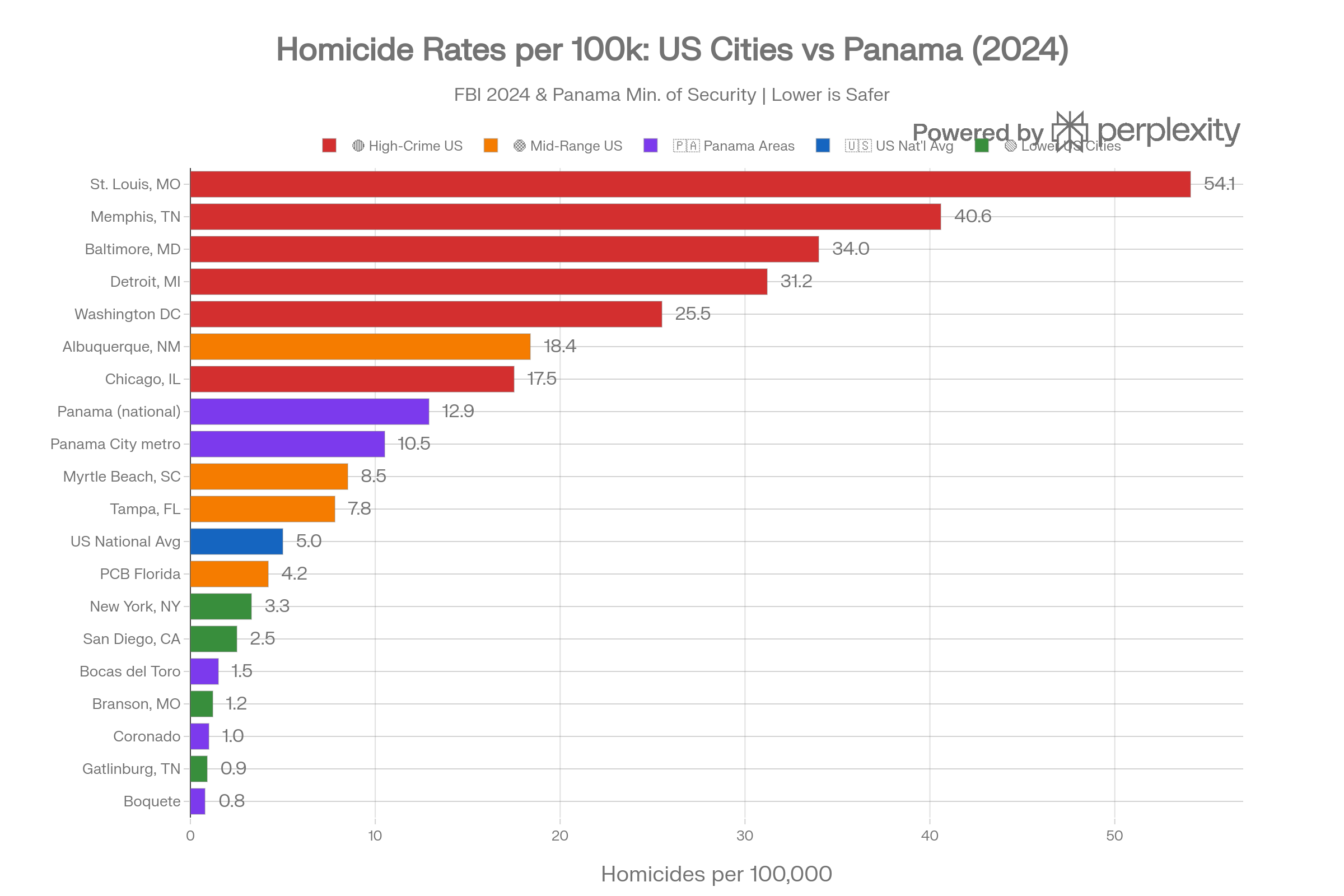
The key is context. Panama's national homicide rate of 12.9 per 100,000 (2024) sounds alarming until you compare it to St. Louis (54.1), Memphis (40.6), Baltimore (34.0), or Detroit (31.2) — all major American cities. More importantly, Panama's violence is highly concentrated in specific urban areas and drug-corridor zones that are entirely separate from where expats live. In the expat communities, violent crime rates are low by any international standard.

This page uses official 2024 crime data from the FBI and Panama's Ministry of Security to give you an honest, side-by-side comparison — by city type, by region, and by what actually matters for daily life.

The Numbers at a Glance

54.1St. Louis homicide rate per 100k
17.5Chicago homicide rate per 100k
5.0US national average per 100k
12.9Panama national rate per 100k
<1.5Boquete / Coronado est. rate
75%Panama homicides in Panama City & Colón only

Homicide Rate Comparison — 2024

Homicides per 100,000 residents across US cities vs Panama's national and expat area rates

Homicide rate comparison chart US cities vs Panama 2024

Sources: FBI Uniform Crime Reports 2024 (US cities) | Panama Ministry of Public Security 2024 | Expat community estimates for Boquete, Coronado, Bocas (municipal-level data not separately published)

Urban City Comparison — Panama City vs Major US Cities

Comparing Panama City's metropolitan area to US cities of similar character and scale

City Homicide Rate
(per 100k, 2024)
Violent Crime
(per 100k, 2024)
Notes for Context
St. Louis, MO 54.1 ~2,100 Consistently one of the most dangerous large cities in the US
Memphis, TN 40.6 ~2,501 Highest violent crime rate of any large US city in 2024
Baltimore, MD 34.0 ~1,400 Persistent high homicide rate despite decline from peak years
Detroit, MI 31.2 ~1,800 One of the most violent large US cities per capita
Washington, DC 25.5 ~1,200 Homicide increase in recent years despite overall crime decline
Chicago, IL 17.5 ~850 High total homicides but lower per-capita rate than 20+ US cities
Albuquerque, NM 18.4 ~1,100 Property crime among highest in US alongside high homicide rate
Tampa, FL 7.8 ~550 Mid-range; lower homicides but elevated property crime
New York, NY 3.3 ~400 Very low homicide rate for a major city; improved dramatically since 1990s
San Diego, CA 2.5 ~310 One of the safer major US cities; low homicide rate
🇺🇸 US National Average 5.0 ~359 FBI 2024 — 15% drop in murders from 2023; all-time lows
🇵🇦 Panama (National) 12.9 75% concentrated in Panama City metro & Colón province
🇵🇦 Panama City (expat zones) ~4–6 Low Costa del Este, Punta Pacifica, San Francisco — very low crime for expats; comparable to US average
✅ Key Insight — Panama City

Panama's national homicide rate is skewed by concentrated gang violence in specific barrios (El Chorrillo, Santa Ana, Curundu, Colón) that are completely separate from where expats live. In established expat neighborhoods — Costa del Este, Punta Pacifica, Obarrio, San Francisco — residents consistently report safety levels comparable to mid-range US suburbs. Panama City's homicide rate is dramatically lower than Chicago, Detroit, Baltimore, Memphis, and many other major US cities that Americans consider normal places to live.

Mountain Town Comparison — Boquete vs US Retirement Towns

How Panama's premier highland community stacks up against popular US retirement mountain towns

Mountain Town Homicide Rate
(per 100k)
Property Crime
(per 100k)
Context
🇵🇦 Boquete, Panama <1.0 Very low Tiny expat-retiree community; violent crime essentially absent from expat areas; petty theft only occasional concern
Branson, MO ~1.2 ~2,200 Tourist-heavy town; property crime elevated by transient population; overall considered safe
Gatlinburg, TN ~0.9 ~2,800 Very low violence but high property crime driven by tourism and traffic volume near Smoky Mountains
Sedona, AZ ~1.0 ~1,400 Popular retiree and spiritual tourism destination; low crime, good safety profile
Asheville, NC ~6.5 ~4,100 Popular mountain city with rising crime in recent years; higher than average for its region
Flagstaff, AZ ~7.5 ~3,500 College town with elevated violent crime; considerably higher than similar-sized mountain towns
✅ Key Insight — Boquete

Boquete consistently ranks as one of the safest towns in all of Panama — and in the broader Central American context. The expat and Panamanian community there reports virtually no violent crime in the areas where residents live. Petty theft exists (primarily vehicle break-ins and opportunistic theft), and basic precautions apply — but the violent crime rate is estimated at well under 1.0 per 100,000, comparable to the safest small towns in the United States and dramatically safer than popular US mountain retirement towns like Asheville or Flagstaff.

Beach Town Comparison — Panama's Pacific Coast vs US Beach Destinations

Coronado and Panama's Pacific coast communities vs Florida, the Carolinas, Alabama, and California

Beach Area Violent Crime
(per 100k)
Property Crime
(per 100k)
Context
🇵🇦 Coronado, Panama Very low (<100) Low Gated community infrastructure; expat-focused; very safe daily life; occasional vehicle theft
🇵🇦 Pedasí / Azuero, Panama Extremely low Very low Rural, slow-paced; one of the safest corners of Panama; minimal crime of any type
Gulf Shores / Orange Beach, AL ~180 ~2,400 Orange Beach ranked among Alabama's safest cities; tourism-driven property crime elevated seasonally
Hilton Head / Lowcountry, SC ~150 ~2,100 Gated resort community with low violence; property crime elevated in summer tourist season
Myrtle Beach, SC ~700 ~4,900 176% more violent crime than US national average; 207% more property crime; among most dangerous beach towns
Panama City Beach, FL ~400 ~3,800 Spring break/tourist-heavy crime spikes; higher crime than comparable beach towns
Outer Banks, NC ~80 ~1,200 Among the safest US beach areas; very low crime driven by rural character and year-round community
Santa Barbara, CA ~250 ~2,100 Upscale California beach city; mid-range crime relative to California overall
Miami Beach, FL ~450 ~4,200 Tourist-heavy urban beach; higher violent crime than most beach destinations
San Diego Beach Areas ~310 ~1,670 City-level data; individual beach neighborhoods (La Jolla, Del Mar) significantly lower
✅ Key Insight — Panama's Pacific Coast

Coronado and Panama's Pacific coast communities are structurally very different from US beach towns — they are primarily residential, not tourism-driven party destinations. This dramatically changes the crime profile. Unlike Myrtle Beach (176% above US average for violent crime) or Panama City Beach (a spring break focal point), Coronado is a settled community of Panamanian families and expat residents with gated infrastructure, low transient traffic, and a calm daily atmosphere. The comparison to the Outer Banks or Hilton Head is more apt — and by that comparison, Coronado holds up very well.

⚠️ Areas to Avoid in Panama

Understanding Panama's safety landscape requires understanding where crime is actually concentrated. The good news: the areas of concern are specific, well-known, and clearly separated from where expats and tourists spend their time. Avoiding dangerous areas in Panama is straightforward once you know which neighborhoods and cities to steer clear of.

🚨 High Risk — Avoid
Panama City Neighborhoods
  • El Chorrillo — Historically the most dangerous neighborhood; concentrated gang activity
  • Santa Ana — High street crime; exercise extreme caution
  • Curundu — Avoid entirely; concentrated poverty and crime
  • San Miguelito — Parts of this suburb have elevated crime; know the specific areas
  • Río Abajo — Elevated crime; not recommended for visitors
  • 24 de Diciembre — Avoid; high crime density
Colón City

Colón has the highest concentration of violent crime and gang activity in Panama. The city itself (outside the secured Free Trade Zone perimeter) should be avoided entirely. Travel directly to and from the Free Trade Zone and do not walk city streets.

⚠️ Use Extra Caution
Darién Province

The Darién Gap — Panama's remote southeastern jungle bordering Colombia — is a drug and human trafficking corridor. The town of La Palma and areas near the Colombian border present serious safety risks. Never travel into the Darién jungle without an organized, reputable guide. Tourists have been harmed here.

Parts of Panama Oeste

Some communities in the greater Panama Oeste province (La Chorrera suburban areas, Arraiján) have elevated crime. These are not expat areas and are generally avoided anyway.

Late-Night in Casco Viejo

Casco Viejo itself is increasingly safe and popular. But the immediately surrounding neighborhoods after dark — particularly the edges adjoining El Chorrillo — require caution. Stick to the lit tourist areas and use Uber to leave.
🗺️ The Geography of Safety

Panama's crime geography follows a consistent pattern: urban poverty zones in parts of Panama City and Colón account for the vast majority of violent incidents. The provincial towns (Boquete, David, Chitré, Las Tablas), coastal communities (Coronado, Pedasí, Bocas), and highland areas (El Valle, Volcán) are overwhelmingly peaceful. Panama's geography naturally separates these worlds — you do not accidentally wander from a safe expat zone into a dangerous neighborhood the way you might in US cities where high and low crime areas can be blocks apart.

Practical Safety Tips for Expats

Most of these are the same common-sense precautions you would apply in any city in the world — they are not Panama-specific, and following them means crime is rarely an issue for expats in their daily lives.

Use Uber, not street taxis at night

Registered ride-share apps are the safest transport option at night. Yellow taxis carry a small but real risk of "express kidnapping" in tourist areas. Uber/DiDi eliminates this entirely.

Don't display valuables

Leave expensive jewelry and watches at home or in a safe. Don't walk while looking at your phone in unfamiliar areas. This applies equally in any US city.

Know which neighborhoods to avoid

El Chorrillo, Santa Ana, and Curundu in Panama City. All of Colón city outside the Free Trade Zone. Stick to known expat areas and tourist zones. You will quickly learn the geography.

Register with the US Embassy

The US Embassy's STEP (Smart Traveler Enrollment Program) is free and ensures you receive official safety alerts and can be contacted in an emergency. Takes 5 minutes at travel.state.gov.

Secure your home and vehicle

Most expat housing includes security features. Don't leave valuables in parked cars. Use secure parking where available. Vehicle break-ins are the most common property crime affecting expats.

Trust your community network

Expat communities in Boquete, Coronado, and Panama City are tight-knit and actively share safety information. Local Facebook groups provide real-time alerts on any incidents. Join them early.

The Bottom Line on Safety

Panama is safer for daily expat life than the statistics initially suggest — and considerably safer than many American cities that people live in without concern. The key is understanding where crime is concentrated (specific urban zones, away from expat areas) and applying the same common-sense precautions you would anywhere in the world.

For context: living in Boquete or Coronado is statistically safer than living in Chicago, Tampa, Albuquerque, Myrtle Beach, or dozens of other US cities and beach towns. Most long-term expats report that crime concerns — which loomed large before the move — faded quickly after arriving and experiencing daily life in their chosen community.